


Was your child injured during labor or delivery in Portland, OR? If a preventable act or omission by an obstetrician, a midwife, or the hospital caused the harm, the Portland birth injury lawyers at Angel Law, P.C. can help your family recover the cost of a lifetime of care. Call (503) 953-8224 today for a free, confidential consultation.
Birth injuries are often serious and permanent. Treating one takes a range of specialists over your child’s life, and the cost runs well past medical care: speech therapy, rehabilitative therapy, assistive equipment, and years of other services. When medical missteps or negligent care caused that, you and your child should not be the ones paying for someone else’s carelessness.
Our lead attorney, Patrick D. Angel, has represented injured Oregonians since 2003 and recovered millions in settlements and verdicts, including medical malpractice verdicts returned where the defense had made no offer before trial.
Schedule a free consultation with a birth injury attorney in Portland. If you cannot travel, we will come to you.
Turn to Angel Law, P.C. for Trusted Counsel & Support

Top 100 U.S. Verdict
Our verdict against a Portland hospital was listed among the Top 100 medical malpractice verdicts in the United States for 2019.

23 Years of Trial Experience
Patrick D. Angel has represented injured Oregonians since 2003 and has trial experience in many cases.

Oregon Bar Section Chair
Elected chair of the Oregon State Bar Products Liability Section, and on its executive committee since 2010.

You Pay Nothing Unless We Win
No retainer. No hourly fees. We advance case costs and are repaid from the recovery.
How Do I Know If I Have a Birth Injury Case?
You have a birth injury case only if birth injury negligence caused the harm. Oregon law compensates a preventable injury, not an unavoidable one, and that distinction is what decides whether your family has a claim. It was preventable if the harm came from a decision somebody made, or failed to make, rather than from a complication nobody could have controlled.
You usually cannot tell which it was from what you were told at the hospital. The people explaining it to you are the same people who provided the care, and what they are giving you is a clinical impression, not an independent review.
In legal terms, preventable means a doctor, nurse, or midwife did not meet the standard of care another competent professional would have met in the same circumstances, and that failure caused your child’s injury. These are the failures that most often produce a birth injury claim in Oregon:
- Failing to monitor the mother and baby properly during labor, or missing what the fetal monitoring strips were showing.
- Delayed diagnosis of fetal distress, or recognizing the distress and not acting quickly enough.
- Failing to order an emergency C-section when the baby’s condition called for one.
- Failing to diagnose and manage maternal conditions such as preeclampsia, infection, or gestational diabetes.
- Failing to account for the baby’s size and position before delivery, which is what turns shoulder dystocia into a brachial plexus injury.
- Misusing forceps or a vacuum extractor, or continuing with one after it should have been abandoned.
- Pulling or twisting the baby improperly during a difficult delivery.
- Failing to provide adequate prenatal care, including screening that would have flagged a high-risk pregnancy.
- Failing to have qualified staff present for a delivery already known to be complicated.
- Failing to transfer a newborn to the NICU promptly when the baby needed that level of care.
An obstetrician with no connection to your delivery, reading the monitoring strips against the timeline, can tell you which of these happened. That review is how the question gets answered. Our Portland medical malpractice lawyers obtain the fetal monitoring strips and the full delivery record at our expense. Start with a free case review.
Common Birth Injury Cases We Handle
These are the conditions we see most often in Oregon birth injury claims. The diagnosis usually determines what the records need to show.
Brain and Oxygen Injuries
- Cerebral palsy: A permanent condition affecting movement and posture, caused by injury to a baby’s developing brain during or around delivery.
- Hypoxic brain damage: Brain damage caused when a baby is deprived of oxygen for too long, also called hypoxia or anoxia, and sometimes the result of untreated jaundice progressing to kernicterus.
- Fetal distress: Signs that a baby is not tolerating labor, and the point at which the delivery team is expected to act.
- Meconium aspiration: When a newborn inhales meconium-stained fluid, which can block the airway and cut off oxygen.
Nerve and Physical Injuries
- Erb’s palsy: Weakness or paralysis of the arm caused by damage to the shoulder nerves during delivery.
- Brachial plexus injuries: Damage to the bundle of nerves running from the neck to the arm, usually from excessive force during delivery, including Klumpke’s palsy and total arm paralysis.
- Birth trauma: Physical injury sustained during delivery, including skull fractures, cephalohematoma, and caput succedaneum.
Maternal Emergencies
- Placental abruption: When the placenta separates from the uterus before delivery, an emergency for mother and baby at the same time.
- Preeclampsia and HELLP syndrome: Dangerous blood pressure and liver conditions in the mother that develop over hours or days and show up in readings somebody has to be tracking.
- Postpartum hemorrhage: Severe bleeding after delivery, highly survivable when blood loss is measured accurately and acted on quickly.
- Premature labor: Labor that starts too early, raising the risk across nearly all of the injuries above.
A mother’s claim and a child’s claim can both arise from the same delivery, and they are separate claims with separate damages. Where a birth injury is fatal, the claim becomes a wrongful death claim brought by the estate.
Tell us the diagnosis, and we will tell you what the records need to show. Schedule your free case review now.
Birth Injury or Birth Defect: Which Do You Have?
A birth injury happens during labor, delivery, or the care around it. A birth defect was already present before labor began. That distinction usually decides whether you have a claim at all.
A congenital condition that formed during pregnancy, including spina bifida, a cleft palate, a heart defect, or a chromosomal condition such as Down syndrome, is generally not caused by delivery care.
Being told your child’s condition was congenital is not automatically the end of it. Two situations still involve negligence:
- A missed prenatal finding led to preventable harm. Undiagnosed gestational diabetes, unmanaged preeclampsia, or any condition that should have changed how the delivery was handled is ordinary medical negligence under ORS 677.095, whether or not the underlying condition itself was preventable.
- The defect was caused by a medication. A drug taken during pregnancy that caused a congenital injury is a dangerous drug claim against the manufacturer, and it runs on a different deadline.
The line is not always obvious, and it is not always what the hospital’s discharge summary says it is. Read our guide on the difference between a birth defect and a birth injury.
Were you told nothing could have been done? A second opinion from outside that hospital is worth having. Reach Angel Law at (503) 953-8224.
What Can You Recover in Compensation for Your Child?
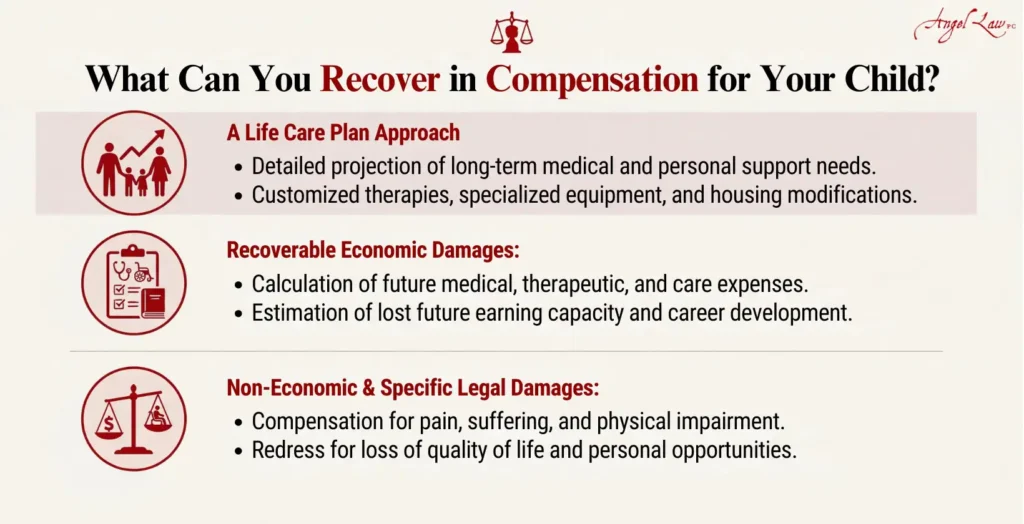
You can recover the full cost of what your child will need for the rest of their life. That figure comes from a life care plan rather than a formula.
A claim can recover future medical and therapeutic care, nursing and attendant care, equipment and home modification, special education, and lost earning capacity. It can recover the medical costs already incurred, and non-economic damages for pain, disability, and the life your child would otherwise have had.
Non-economic damages are the category families most often misunderstand. Oregon’s $500,000 limit under ORS 31.710 applies only to wrongful death claims, so a living child’s claim is not subject to it.
A claim against OHSU or another public body works differently again. ORS 30.269(2) takes it outside the ORS 31.710 cap, and the Oregon Tort Claims Act imposes its own per-claimant limit instead, whether or not your child survived. That figure is adjusted every July, so ask what applies to your year rather than rely on a number you read somewhere.
Read our guide on the lifelong costs of cerebral palsy before you accept any figure, and let us build the number from a life care plan. Dial (503) 953-8224 for a free, confidential review.
How Can Our Portland Birth Injury Attorneys Help
Our team takes the legal side off your hands so you can look after your child. That means requesting and reading the complete record, retaining the obstetric and neonatal experts who can say what should have happened, building the life care plan that establishes what your child will need, and dealing with the hospital’s insurers so you never have to.
- If you cannot travel, we come to you. Families caring for a disabled child often cannot get to an office, so Angel Law meets clients at home or at the hospital instead. One published review describes the founder driving three hours to meet a client.
- Patrick reads the strips himself. Angel Law retains an independent obstetrician to give the expert opinion, and Patrick D. Angel works through the monitoring data alongside that review rather than from a summary of it. The person who argues what the strips show is the person who read them.
- Willingness to try the case in front of a jury. Angel Law has taken Oregon medical claims to jury verdict, including one against a hospital that made no offer at all before trial. Against a well-insured institutional defendant, that willingness is the leverage.
- We work on a contingency fee basis, meaning you pay no fee unless we recover money for you. No retainer, and no hourly billing.
Bring us the records, or let us request them for you. There is no fee and no obligation to find out where you stand. Reach us at (503) 953-8224.
Portland Birth Injury Claim FAQs
How Do I Know Whether My Child’s Condition Was Caused by Malpractice?
You know whether malpractice caused your child’s condition by having an obstetrician outside the delivery read the records. Three records settle it: the fetal monitoring strips, the timing of every intervention, and the neonatal findings. Those three records show whether a warning appeared and what the delivery team did in the minutes after it appeared. Angel Law obtains the records and pays for the obstetric review that reads them.
What Evidence Do I Need to Prove a Birth Injury Case?
You need six kinds of evidence to prove a birth injury case.
- Prenatal records, which establish what the pregnancy was known to carry.
- Fetal monitoring strips, which show distress and the minute it appeared.
- Hospital monitoring data and test results, which date each reading.
- Neonatal charts and imaging, which record the condition at birth.
- Diagnosis and treatment documentation, which names the injury.
- Long-term care records, which establish what the injury costs.
Expert testimony binds the six kinds into one timeline. Angel Law obtains every kind, and Angel Law funds the expert who reads them.
Who Can Be Held Responsible for a Birth Injury?
Five parties can be held responsible for a birth injury.
- The obstetrician, who directs the delivery.
- The labor and delivery nurses, who monitor mother and baby and escalate what they see.
- The midwife, who attends the birth in a hospital, a birthing centre, or at home.
- The anesthesiologist, who administers the epidural or the anesthesia for a cesarean.
- The hospital, which answers for its employees and for its own staffing, supervision, and credentialing.
Each defendant pays its own percentage share, because ORS 31.610 makes liability several and not joint. Many obstetricians contract with a hospital instead of working for it, which makes the hospital’s responsibility for that doctor a separate question.
How Long Do I Have to File a Birth Injury Claim in Oregon?
You have two years from the date you discovered the injury, and no more than five years from the delivery. The five-year limit binds even though your child is a minor, because ORS 12.110(4) applies it notwithstanding ORS 12.160, Oregon’s minor tolling statute. A cerebral palsy diagnosis confirmed at age six falls outside the five-year period. Care at OHSU or another Oregon public hospital carries a shorter clock: 180 days for notice, and one year for wrongful death. Call before you conclude a claim expired, because the start date and any concealment change the count.
How Much Does a Portland Birth Injury Lawyer Cost?
A Portland birth injury attorney at Angel Law costs you nothing up front and nothing by the hour. Angel Law works on a contingency fee, which means the firm takes a percentage of a recovery and takes nothing without one. Case costs follow the same rule: we advance the records, the obstetric review, the expert reports, and the filing fees, then recover them from the settlement or verdict. The consultation costs nothing and carries no obligation.
Is HIE the Same as a Birth Injury?
Yes, HIE, or hypoxic-ischemic encephalopathy, is a birth injury caused by oxygen loss to a newborn’s brain around delivery. Doctors call the same event birth asphyxia, and it is the injury that most often produces a cerebral palsy diagnosis later.
Talk to a Portland Birth Injury Lawyer
If your child was injured during labor or delivery, the five-year limit is already running, and it does not wait for a diagnosis. Finding out where you stand costs nothing.
Angel Law, P.C. is at 385 1st Street, Suite 215, Lake Oswego, OR 97034, and gives legal help to families across Multnomah County and throughout Oregon. Speak with a Portland birth injury attorney. Call us at (503) 953-8224, or fill out the consultation form below.