



A hospital admission was supposed to fix one health problem. Instead, a missed diagnosis, a surgical error, or an unprevented fall left you with a catastrophic second injury on top of the first, and a stack of medical bills that keeps growing. You are likely wondering whether a hospital or a well-insured doctor can really be held accountable for medical negligence, and whether your medical records even support a legal claim.
Patrick D. Angel took a Portland hospital negligence case to a jury verdict after the hospital refused to make any settlement offer for the patient’s severe injuries. He has practiced law in Oregon since 2003, and Angel Law, P.C. keeps its caseload small, so an experienced medical malpractice attorney reads your full medical record himself.
Call (503) 862-8666 to share what happened, or use our contact form to request a free case evaluation based on what your medical records show. If you prefer an in-person meeting, our office is located at 385 1st Street in Lake Oswego, and your initial consultation is always free. Our Portland personal injury lawyers make it easy – available 24/7 and willing to travel to you.





Why Portland families trust Angel Law for complex medical claims
- 20+ Years of Oregon Trial Experience: Licensed attorney in Oregon since 2003, admitted to practice in Oregon state courts, the Oregon Court of Appeals, and the U.S. District Court for the District of Oregon.
- Recognized Legal Excellence: Selected to Oregon Super Lawyers every year from 2014 through 2026 (Thomson Reuters).
- Leadership in the Bar: Elected chair of the Oregon State Bar’s Product Liability Section (2015–2016).
- Proven Courtroom Verdicts: Recovered a $2,225,000 jury verdict ranked among TopVerdict.com’s Top 100 U.S. Medical Malpractice Verdicts for 2019.
- Selective Caseload: We intentionally limit our caseload so every client receives dedicated, personalized representation.
- No Upfront Costs: Contingency fee structure. No attorney fees unless we win your medical malpractice lawsuit, and we advance all case costs.
When No Settlement Offer Came, We Took the Case to TrialA hospital patient fell and suffered a traumatic brain injury. The hospital never made a settlement offer. Patrick D. Angel took the case to a jury and won $2,225,000, a verdict TopVerdict.com ranked #78 among the Top 100 U.S. medical malpractice verdicts for 2019. Was a fall in a hospital written off as an accident nobody could have prevented? Bring us the chart. The risk assessment, the rounding log, and the staffing record for that shift usually settle the question. Call (503) 862-8666 and our staff will take the details. Past results do not guarantee a similar outcome. The value and outcome of every case depend on its individual facts and circumstances. |
A hospital that never made you an offer has not decided your case for you. Call (503) 862-8666 and walk Patrick through what happened.
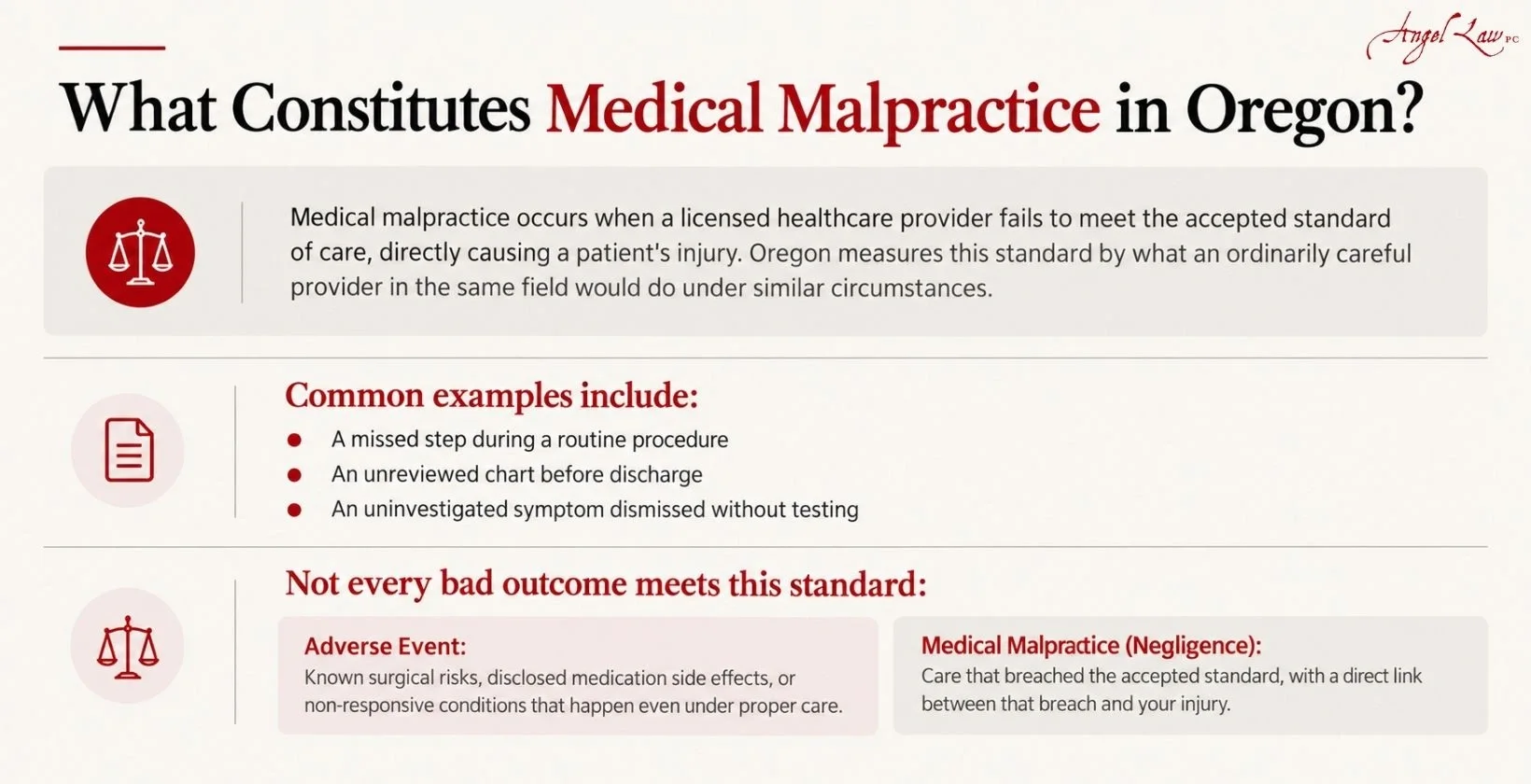
What Constitutes Medical Malpractice in Oregon?
Medical malpractice occurs when a licensed healthcare provider fails to meet the accepted standard of care, directly causing a patient’s injury. Oregon measures this standard by what an ordinarily careful provider in the same field would do under similar circumstances. Common examples include:
- A missed step during a routine procedure
- An unreviewed chart before discharge
- An uninvestigated symptom dismissed without testing
Not every bad outcome meets this standard:
- Adverse Event: Known surgical risks, disclosed medication side effects, or non-responsive conditions that happen even under proper care.
- Medical Malpractice (Negligence): Care that breached the accepted standard, with a direct link between that breach and your injury.
Medical malpractice and medical negligence carry subtle legal distinctions in court, but describe the same core failure for a patient. Reviewing the complete medical record is how the line between a known risk and actionable negligence becomes clear.
Common Types of Medical Malpractice Claims We Handle
We handle medical malpractice claims across seven recurring categories, including birth injuries, surgical errors, and defective devices.
Birth Injury Claims
Harm to a baby during labor or delivery, sometimes not clear until years later when a child misses developmental milestones.
Surgical Errors
A wrong-site procedure, a retained instrument, or a mistake made during the operation itself.
Medical Misdiagnosis
A condition missed or diagnosed late while the window for effective treatment closed.
Hospital Negligence
Unsafe staffing, an unanswered call light, or a fall your own chart flagged as likely.
Defective Medical Devices
A hip or knee implant, a stent, or surgical mesh that failed after it was placed in your body.
VA Medical Claims
Negligent care at a VA hospital, pursued through a federal claims process rather than Oregon’s state court system.
Dangerous or Defective Drugs
A medication prescribed, dispensed, or dosed incorrectly, or a drug that was unsafe when it reached you.
Do not see your situation listed. Medical malpractice reaches beyond these seven categories, and the fastest way to learn where yours fits is a call to (503) 862-8666.
The Four Elements of a Medical Malpractice Claim
Every Oregon medical malpractice claim requires proof of four elements: duty, breach, causation, and damages.
- Duty. The provider owed you a professional duty of care once treatment began.
- Breach. The provider’s care fell below the accepted standard described above.
- Causation. The breach caused the harm, not the condition you already had.
- Damages. The harm produced a measurable loss: medical costs, lost income, or pain and disability.
Causation is the element most cases turn on, because an independent medical expert has to connect the breach to the harm before a claim moves forward.
Who Can Be Held Liable in a Medical Malpractice Case?
A malpractice claim can name the treating provider, the hospital or clinic that employed them, or both, depending on who controlled the decision that caused the harm.
The Treating Provider
A doctor, nurse, physician assistant, or another licensed provider carries personal responsibility for the specific decision that fell below the standard of care. That responsibility follows the provider even when the mistake happened inside a large institution.
The Hospital or Clinic
A hospital is responsible for a provider’s mistake when that provider is a direct employee acting within their job. The hospital’s own liability grows further when it knew about a provider’s prior problems and let them keep treating patients anyway. These claims often target the institution’s own systems: staffing levels, supervision, and how quickly a warning sign gets acted on.
Responsibility changes when a hospital’s own system, not one provider’s judgment, lets you down. Reach out now, and we will help sort out who is actually liable.

Oregon’s Statute of Limitations and Statute of Repose for Med Mal Cases
Oregon gives you two years from the date you discovered the injury to file a medical malpractice claim, and no case survives past five years from the treatment itself.
Governed by ORS 12.110(4):
- Two-Year Statute of Limitations: Starts when you discovered the injury or reasonably should have discovered it, not on the date of the procedure.
- Five-Year Statute of Repose: Runs from the treatment itself regardless of discovery. A minor’s age does not extend this deadline.
- Fraud Exception: If a provider’s fraud, deceit, or misleading representation caused you to miss the five-year deadline, you get two years from the date you discover that concealment to file.
- Public Providers (OHSU, County Hospitals): Subject to the Oregon Tort Claims Act, which requires separate notice: 180 days for most claims, one year for wrongful death.
Medical Malpractice Damages in Oregon: What Compensation Can You Recover?
Oregon allows medical malpractice victims to recover economic damages like medical bills, lost income, and future care costs in full, while non-economic damages for pain, suffering, and disability carry no dollar cap for surviving patients.
Economic Damages
Covers objective financial losses, including past medical expenses, expected future treatment, and lost wages or diminished earning capacity.
Non-Economic Damages
Covers subjective harms like physical pain, emotional distress, and loss of quality of life. The Oregon Supreme Court struck down the $500,000 cap on non-economic damages for ordinary personal injury claims, leaving surviving patients’ compensation uncapped. (Note: The $500,000 limit under ORS 31.710 still applies to wrongful death claims).
Punitive Damages
Awarded only in rare, egregious circumstances. ORS 31.740 shields most licensed health care providers who act within their scope of care without malice, meaning simple medical negligence does not qualify.
Malpractice claims against a public provider, such as OHSU or a county-run facility, are capped differently under the Oregon Tort Claims Act.
What your claim is worth depends on your medical bills, your lost income, and the record of your pain and limitations, not a number guessed over the phone. Call (503) 862-8666 for a free read on what your case may support.
What We Have Recovered for Medical Malpractice Clients
| Result | Case Details |
|---|---|
| $5,000,000 Settlement |
The Portland VA missed the risk of a pulmonary embolism during surgery, causing a spinal cord injury and partial paralysis. |
| $2,225,000 Jury Verdict |
A hospital patient fell and suffered a traumatic brain injury. No settlement offer was ever made. |
| $850,000 Settlement |
A flesh-eating infection went undiagnosed after abdominal surgery. |
| $300,000 Settlement |
A high fall-risk patient was left to reach the bathroom unassisted, and the fall caused a brain bleed. |
Past results do not guarantee a similar outcome. The value and outcome of every case depend on its individual facts and circumstances. View our other case results.
Your own medical record may already contain what a case like these needs. Schedule a case review, or visit our Lake Oswego office and tell us what the chart says.
The Attorney Handling Your Case
A hospital defending a malpractice claim has an insurer and a risk management team that handle these cases every week. Patrick D. Angel took one of these claims past a refused settlement offer and let a jury decide it instead.
We limit how many cases we accept each year for the same reason. A medical record takes real time to read closely, and Patrick reads every page himself. Once we take your case, Patrick prepares it and stands up at trial if it comes to that.
Hear what our past client has said:
“Patrick was extremely helpful and willing to share his knowledge for free! He responded faster than any other law firm in Oregon which is amazing when you are on a time limit!”
– Alli Crouse

Common Questions About Medical Malpractice Lawyers in Portland
What Should I Do If I Suspect Medical Malpractice?
Request a full copy of your medical records before you do anything else, including every note, test result, and discharge summary. Write down what happened while the details are fresh, with dates and the names of everyone involved. Avoid confronting the provider directly, since that conversation can complicate a later claim. An independent medical expert generally has to review your records before anyone, including us, can tell you whether a claim exists.
Do I Need a Lawyer to File a Medical Malpractice Claim in Oregon?
Oregon law does not require an attorney to file a malpractice claim, but self-representation rarely succeeds. These cases demand expert testimony, strict filing deadlines, and technical proof of the standard of care. The Oregon State Bar publishes general guidance on how these claims work.
How Long Does a Medical Malpractice Lawsuit Take?
A medical malpractice lawsuit can take 1 to 3 years to resolve in Oregon. Cases that settle move faster than cases that reach trial. Expert review, discovery, and the defense’s investigation add time before either side discusses a number. Clear liability and documented damages shorten the timeline. Contested causation extends it.
Can I Afford a Medical Malpractice Attorney?
Yes, contingency fees make a medical malpractice attorney affordable regardless of income. You pay nothing unless we recover money for you, and we advance every cost of expert review and litigation upfront. Our contingency fee structure page explains the exact percentage and when it applies to your case.
What Is the Hardest Part of a Medical Malpractice Case to Prove?
Causation is usually the hardest element to prove. Showing that a provider’s care fell below the standard is often straightforward once the chart is reviewed, but showing that failure, rather than the illness you already had, caused your specific harm takes an independent medical expert willing to say so under oath.
Speak With a Portland Medical Malpractice Lawyer Today
When a medical mistake upends your life, you deserve real answers, not unanswered questions or empty assurances. Tell Patrick what happened, and let him give you an honest, clear look at what your medical records actually show.
Call (503) 862-8666 or request a consultation online. We will review your records step-by-step and explore every legal option so you can choose the best path forward.
Angel Law, P.C.
385 1st Street, Suite 215
Lake Oswego, OR 97034
You can visit us at our main office. See our Lake Oswego medical malpractice lawyer page for more information, or if you are unable to travel, we will gladly bring our consultation to you.